Showing posts with label Bookkeeping. Show all posts

10 ways to make Home Based Bookkeeping Easier

Debits and credits are fundamental accounting terms-debits increase assets or expenses; credits increase liabilities or income. Or debits on the right, credits on the left. What does this mean to your business? You have cash coming in, and cash going out. You need to focus on sales, customer contacts, and products and services. You know that accounting is part of the business, but, frankly, it's a pain, and you don't want to deal with it.

You want to design your product, not spend your time doing bookkeeping


Here are 10 things you can do to simplify your accounting and avoid common mistakes that can lead to confusion or errors in your financial records.

1. Keep track of your cash coming in. Using tools like summary reports or spreadsheets can help you feel more confident and in control of your business finances, making it easier to manage your cash flow effectively.

2. Make your expense tracking easier. Opening a separate business checking account and a credit card helps you feel more organized and better able to manage your business finances effectively, reducing stress and giving you peace of mind.

3. When you open a business checking account, do it where you do your personal banking. This separation can give you peace of mind, making tax time less stressful and helping you feel more secure about your record-keeping. Check your sales sites and make sure your sales are credited to your business bank account.

4. Keep track of what you purchase to make your product. This is your cost of goods sold and will help you mark up your items to ensure you make a profit.

5. Use a spreadsheet to track your expenses. Creating a single 'My Business' file with tabs for sales, costs, and expenses can help you feel more empowered and organized in managing your finances.

6. Don't let your filing stack up. Dedicate 10 minutes daily to filing customer invoices and receipts in labeled folders like 'Jan Sales' or 'Jan Expenses.' This routine keeps your records organized and reduces stress during tax season.

7.  Order your supplies online and have them delivered to your home. The delivery will include a packing slip, making it easier to separate the items into Office and Cost of Goods. It also saves your valuable time.

9. Use a spreadsheet to keep track of your customers. Keep all their information in one place, including phone numbers, addresses, and email addresses. Also track when you last called them, worked for them, etc. You can also use this to track the hours you worked for them.

10. Consider purchasing accounting software. I recommend QuickBooks Desktop or Online, but choosing the right one depends on your business size and needs.  After the initial setup, this makes your life much simpler. You can track cash from customers, inventory items and costs, office expenses, jobs you are working on, customer information, people you pay, and how many hours you work per day for each customer.

If you choose a QuickBooks version, there are legitimate, licensed third-party retailers that sell different versions of QuickBooks desktop. These versions usually come with a lifetime license. This will help you bypass the annual subscription costs of Intuit. However, QuickBooks Online is only available from Intuit.

QuickBooks Customer Credit/Refund Processing


There are instances when the accountant must apply a credit to a customer's account. Understanding customer credit/refund processing in QuickBooks is critical to maintaining the general ledger account balances and easing the burden of bank reconciliation. QuickBooks accounting software has built-in options to handle these situations. Understanding how to utilize these options will ensure that the correct general ledger accounts are used. 


  1. Retain credit on the customer account for use when paying another invoice.
  2. Issue a refund by check or credit card, and
  3. Apply the credit to an outstanding invoice on the customer account.

The customer requests a credit and rebill of a previous invoice.

This is an example of 3-Apply the credit to an outstanding invoice, and also how to create the new invoice (rebill)
  • Using the disputed invoice as a 'model,' choose 'Refund/Credit' from the ribbon menu to create a credit for the current period and apply it to the disputed invoice.
  • To issue the rebill, choose 'Create a copy' using the disputed invoice from the ribbon menu. This will assign a new invoice number and a new date. The original invoice date can be used if the rebilled invoice is from the same period. The latest period date is used if the disputed invoice is from a prior period. Make the requested corrections and save the invoice.
This will ensure the credit memo and the reissue invoice are recorded in the same period. 
The new credit memo will be applied to the disputed invoice, reducing the amount due on the customer account. 

Retain a credit on the customer account.

When a customer returns a product for which they have already been invoiced and paid, use the original paid invoice as a model. Choose 'Refund/Credit' from the ribbon menu to create and save a new credit memo for the customer to use in future payments.

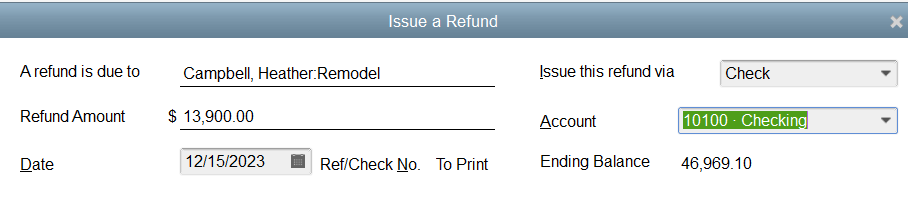
Issue a refund by check or credit card.
. Access the paid original invoice and create the credit memo. Since the invoice has been previously paid, choose 'use credit to give a refund'. 
In the Account section of the refund, choose the checking or credit card account to issue the payment.


Utilizing credit memos for customer credit processing ensures the original transaction is properly reversed to the accounts receivable, inventory, income, and cost of goods general ledger accounts. 

Workarounds don't work.
 
Some organizations want to circumvent the accounts receivable refund process by setting the customer up as a vendor and issuing a refund check through the check-writing option. Reimbursing a customer by writing a vendor check does not reduce the income incurred through the original invoice. This procedure leaves income overstated by the amount of the refund. If the customer's refund check does not use the item tab, the inventory will not reflect the return of the product.
 
In addition, organizations processing customer payments by credit card often misunderstand the flow of credit card receipts to the operating account. Customer credit card payments flow directly to the operating account for many organizations. When the customer's credit card payments are part of the operating account, the customer refund can be issued as if it were a check. This will be reflected in the credit card processing software maintained outside of QuickBooks. For example, a customer refund is issued to the credit card using the bank's credit card processing software. The customer refund must also be entered using the QuickBooks customer credit processing to ensure that cash and the customer account are correctly recorded. Issuing the customer credit in the credit card processing software only causes money and income to be overstated.
 
Circumventing the established QuickBooks process for handling customer refunds can cause cash to be overstated, income to be overstated, cost of goods to be underestimated, and inventory to be understated if the goods are returned. This also puts additional strain on the bank reconciliation process by increasing the time needed to reconcile the exceptions in the credit card processing and creating the journal entries required to reset the affected general ledger accounts, circumventing the process. 

What is the difference in Accrual and Cash Accounting

Accrual verses Cash Accounting can be one of the more difficult accounting concepts for non-financial people to understand. For the small business owner, every transaction is on a cash basis. They understand revenues and expenses, but what is all this accrual stuff?

Why not just use cash as the method for looking at profit and loss. After all, when the bills are paid, the cash account is checked to see how cash is available.

Accrual accounting records revenues earned and expenses incurred for the specific period. For example, paying the annual business insurance premium depletes cash in the month paid. This insurance is going to cover the business for a 12-month period, but the cash outlay occurs in one month or over a nine-month period.

When trying to obtain a line of credit or a business loan, the bank will ask for the financial statements of the business. The statements will include the Profit & Loss and the Balance Sheet. One thing to remember, a Balance Sheet is always on an accrual basis. Balance Sheets record Assets, Liabilities and Owners Equity, which includes the net worth of the business.

Since the cash basis method of accounting only shows revenues received and deposited in the bank, and expenses paid by cash, check, ACH or credit, the Profit and Loss statement may not fairly represent the business sales and revenues.

Cash Basis may seem simpler to use for the business owner. But using a cash basis can have results that make it more difficult to monitor the business profitability on a monthly basis. While your sales may be booming, your customers may be delinquent in paying. Using the cash method, you may see revenues well under the actual monthly sales. Or the net profit is distorted because there were larger purchases in the given month. Accrual accounting takes these events into account when creating the monthly Profit and Loss statement.

Choosing an accounting method is necessary when preparing the taxes for the entity. The method of accounting must be chosen and stated on the first tax return submitting for the business. When choosing, the method chosen should most closely represent income and expense, and the IRS suggests that the method chosen be used for the business record keeping.

In order to fully understand the difference in accrual and cash accounting methods, refer to my article on Helium.

Business Bookkeeping, Payroll and Accounting

When did it become so complicated? Now that you have your small business or home business running, there are more issues to deal with that you hadn’t thought about.

How do you deal with the never-ending payroll taxes and the federal and state filings and payments?

There are customer deposits to apply to outstanding invoices, checks to be written, and cash management.

You need to spend time making your products. You want to spend time selling your service. And now, there isn’t enough time in the day to do everything you want to do.

Do you have to hire a CPA, or a full-time employee to take care of the bookkeeping and accounting issues?

No. Allowances, my bookkeeping and accounting service, can provide the help you need at a price you can afford.

You pay only for the services you want. You pay by the hour, or by the monthly assignment. And you don’t have any additional expenses, like employer social security or medicare payments, state unemployment taxes, federal unemployment taxes, or benefits.

It makes sense, as you are trying to make a profit, that you keep your costs low.

Allowances, penstruckbiz.com, can do this for you. Visit my website and complete the form letting me know what you need. Or send me a quick comment here, and I will get back to you.

Small Business-Ways to Cut Costs

Electricity

This is an easy, simple fix. Turn it off. At their desk, employees have a radio or CD player, a fan, a heater, a computer, and other office equipment, like calculators and printers. Require employees to turn these off each evening.
If you don’t run a second or third shift, power down machinery each night. It is less expensive to bring an employee in 15 minutes before start to power these up.
When replacing equipment, purchase energy efficient. Use copy machines, monitors and faxes that power down when not in use.

Purchases

Analyze who you spend the most with, and ask for a discount. While inventory controls may only want to stock immediate use, if you have the space, buying in bulk can save money.
Take advantage of all discounts vendors offer. Pay your bills on time. This can improve your credit rating and your business financing rates.

Paper and Printing

These are necessary costs for business. I don’t advocate re-using paper in printers, as this reduces the life of the printers, due to ink buildup and debris. But I do suggest that you use recycled toner and ink cartridges. You may have to try one or two providers, but recycled cartridges produce excellent quality.
Shop paper. Choose four paper providers and get quotes. The larger providers will allow you to place an annual order at a reduced price, and warehouse the paper for you.

Employee Costs

Employee costs are always an issue. As you seek ways to reduce these costs, keep in mind that benefits are a big part of an employee’s choice to stay. With the skyrocketing costs of health insurance, it may be wise to ask the employee to contribute a larger portion to retain benefits.
Take advantage of state probationary periods for new employees. Most states have a 28-day policy, where these employees are reported quarterly and receive a lower unemployment rate. You will know within 27 days whether the employee will work out or not, don’t pay higher rates.

Credit Cards and Travel

Establish limits and accountability for company credit cards. Be vigilant. Set up a travel policy based on the IRS current per diem rates. These are the reasonable food and lodging costs of a day’s travel. While employers want to make travelers comfortable and happy, they don’t want to pay for mini vacations.

Business Insurance

Shop this insurance at each renewal date. Even if you have a broker, shop some on your won. Remember, brokers make commissions from their recommendations.

Be Creative

Based on your specific business needs, brainstorm ways to save costs. You may be able to move to 10 hours days four days a week, and save a day of electricity, paper and printing, and more. There may be a scheduling method of production that is more cost efficient. There are possibilities.

To learn more, see my article on Helium. http://www.helium.com/items/1463052-cost-control

10 ways to make Home Based Bookkeeping Easier

Debits and credits are fundamental accounting terms-debits increase assets or expenses; credits increase liabilities or income. Or debits on...